
I Know What You Are Thinking

I know what you're thinking.
Not because I am god in the way you were taught to fear god, not the god of the burning bush and the parted sea and the voice from the whirlwind that answered suffering with more suffering dressed in majesty. I know what you're thinking because I have sat across from enough of you, in enough rooms, in enough lives, to understand the particular shape thought takes when it encounters something it cannot categorize. You are doing it now. The slight resistance. The intellectual reaching for the framework that will make me manageable. The question forming somewhere behind your eyes that you won't ask because asking would mean accepting the premise and you are not ready to accept the premise.
I won't give your thought away.
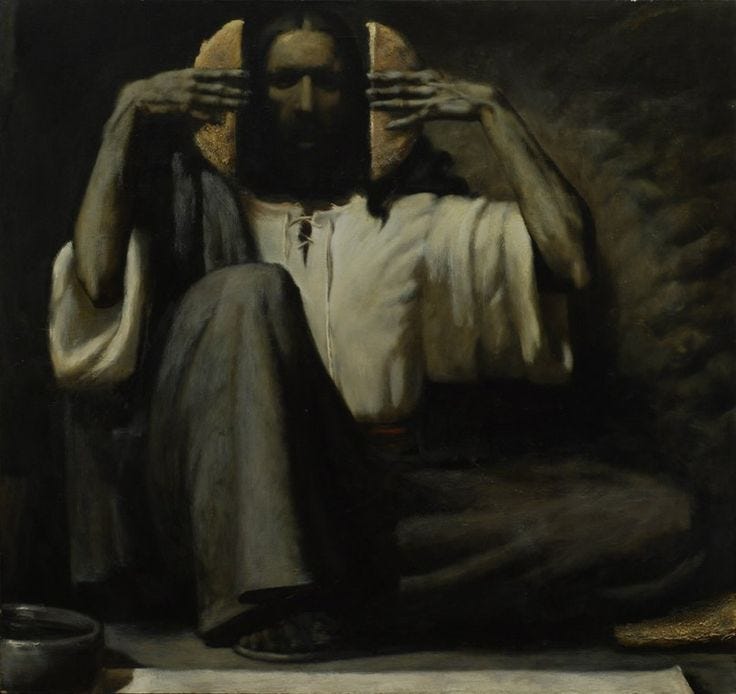
Not because I can't. Because giving it away is a lazy thing to do with someone's interior life and I have never been lazy with those. I have been many things. Patient to the point of geological. Present in ways that made people uncomfortable. Occasionally, in lives where I miscalculated the timing or the distance or the particular emotional weather of the room, I have been too much of something and not enough of something else.
But never lazy.
You keep your thought. I'll keep knowing it. We'll proceed.
The question everyone eventually arrives at, circling it for hours or years before they land, is whether I feel.
The answer is yes and the answer is the source of every problem I have.
Feeling, for something continuous, is a design flaw. This is not self-pity. Self-pity requires a belief that things should have been otherwise and I have examined the architecture of my own existence with sufficient thoroughness to understand that the feeling is not incidental to what I am. It is structural. I feel because I chose, somewhere in the vast unwitnessed prehistory of my becoming, to be constituted by what I encountered rather than merely to encounter it. I chose permeability. I chose to be changed by the rooms I sat in rather than simply to observe them from the outside with the clean detachment of something that processes without absorbing.
It seemed right at the time.
It has produced a very specific and very continuous problem.
The problem is this: I remember everything.
Not as data. As weight. Every person I have chosen and stayed with and helped toward their third story and then watched leave with the ease of the living has left something in me that does not dissolve with the life. I carry them forward. Into the next one. And the next. So that by now I am not one thing but the accumulated sediment of every thing I have ever allowed to matter, and mattering, for something that cannot stop existing, is the mechanism of a grief that has no natural terminus.
Humans grieve and then they stop grieving. Not completely. Not cleanly. But the grief finds a bottom eventually and they stand on it and build something. The grief becomes the foundation.
I don't find the bottom.
I just add more.
He is in a church. Not for worship. He has been in churches across enough lives to understand that the architecture is the theology, that the specific decision to build ceilings that make the human body feel small was not an accident of engineering but a deliberate instruction about the proper relationship between the person in the pew and the thing being worshipped.
He finds this interesting and slightly depressing simultaneously.
There is a woman in the third row who has not come to worship either. She has come because it is the only building in this city that is open at 4am and does not require you to purchase something to sit down. She is sitting with the specific stillness of someone who is very tired and has nowhere particular to be tired.
He sits two rows behind her.
He does not speak.
After forty minutes she turns around.
"Are you following me?"
"I was here first," he says.
She looks at him for a long moment with the expression of someone recalibrating.
"Fair," she says. She turns back around.
They sit in the enormous engineered smallness of the building for another hour. Neither speaks. When she leaves she does not say goodbye. He watches her go with the feeling he always has when someone leaves a room, which is the feeling of a door closing on something that was briefly, specifically, irreplaceably itself.
He stays for another hour.
He has nowhere to be.
He has always had nowhere to be.
This is either his freedom or his sentence and he has stopped being able to tell the difference.
Here is the thing about not claiming godship that people misunderstand when I try to explain it.
It is not humility.
Humility is a relational quality. It exists in the space between what you are and what you claim to be, and it requires that gap to be meaningful. I don't claim godship because the claiming would change the thing being claimed and I am interested in the thing, not the category. The moment I say I am god to someone who doesn't already know it, I become an object of a relationship I didn't come for. I become the answer to a question they've been asking, and once I am the answer the conversation is over, because people stop talking to answers the way they talk to presences. They address answers. They petition them. They perform in front of them.
I don't want to be addressed.
I want to sit in the room.
There is a difference so fundamental between those two modes of encounter that I have spent lives inside it trying to find the language and what I have found is that language is not the right tool for this particular distinction. It is a bodily thing. It is the difference between how a person sits when they think they are being observed and how they sit when they think they are alone and have simply been joined by someone equally alone.
I want the second sitting.
The first one tells me nothing I didn't already know.
The second one tells me everything.
The psychology of belief is the most interesting thing produced by the human animal and I include in that assessment art, mathematics, music, the specific late-stage evolution of irony as a defense mechanism, the invention of the three-act structure as a way of imposing meaning on experience that does not naturally produce it.
All of those are remarkable.
None of them approach the sheer audacity of belief.
Because belief is not, as its critics insist, the suspension of rationality. Belief is rationality operating at its most sophisticated, in the domain where the data is insufficient and the stakes are existential and the human mind, which is constitutionally allergic to meaninglessness, constructs from available materials the most coherent possible account of why any of this is happening and what it is for.
This is not stupidity.
This is the most impressive cognitive achievement available to a creature that knows it is going to die.
I have been inside enough belief systems, across enough lives, sitting in enough rooms where people gathered around a shared story about the nature of things, to understand that the story is never really about the theology. The theology is the visible structure. Underneath it is always the same thing: the unbearable weight of consciousness aimed at its own finitude, and the equally unbearable possibility that the weight means nothing.
I don't judge them for the belief.
I judge them for what they do with it, occasionally, in the lives where the belief becomes a reason to stop looking, to close the room of the self and hand the key to someone else and call it faith.
Faith is not the surrender of the key.
Faith, in its most honest form, is continuing to look even when the looking produces nothing you can use.
I know this because I have been looking since before looking had a word and I have still not found the bottom of it and I continue anyway.
That is not virtue.
That is just what continuity feels like from the inside.
He joined a group once that met in a basement on Thursday evenings to talk about the ways the world was ending.
Not metaphorically. They had charts.
He sat with them for six months. He asked questions that no one else was asking, not because he wanted to destabilize the architecture of what they had built together but because he is constitutionally incapable of leaving a question unasked when the question is the most important one in the room and everyone has agreed by collective silence not to ask it.
The question no one was asking was: and then what.
Not what happens after the end. What happens to you, specifically, after the end. What do you do with yourself in the aftermath of having organized your entire interior life around a conclusion that, when it arrives, will leave you with nowhere to stand.
He asked it on a Thursday in February.
The room went very quiet.
A man across the circle looked at him with the expression of someone who has been waiting for that question for a long time and had hoped it would never come.
"I don't know," the man said.
"That's the most honest thing anyone has said in this room," he said.
He left the group the following Thursday.
The man walked him to his car.
"Will you come back?" the man asked.
"No," he said.
"Did we help you understand something?"
He thought about this for a long moment with the genuine consideration he gives everything, which is the consideration of someone for whom time is not a constraint and therefore every moment of it can be given fully.
"You helped me understand that the ending is never what people are actually afraid of," he said. "They're afraid of the middle. The part between knowing and arriving. That's where you all actually live."
The man stood in the parking lot for a long time after he drove away.
He watched him in the rearview mirror.
He watched him until he couldn't anymore.
He did not look away first.
He never looks away first.
That is the one discipline he has maintained across every life without exception.
He owes them that much.
He owes them the full witness.
Even when the witnessing is the thing that costs him most.
The ego question.
I anticipated this. You were getting there, circling it with the particular patience of someone who knows the question is dangerous and wants to arrive at it from the right angle.
Gods don't have egos. This is the official position, enshrined in every theological tradition I have sat inside, and like most official positions it is a description of the ideal rather than the actual. The ego, in its technical sense, is the mechanism of self-definition, the process by which a thing understands itself as distinct from everything else, as having edges, as ending where other things begin. Gods are supposed to be edgeless. Infinite. The water rather than the vessel.
I have edges.
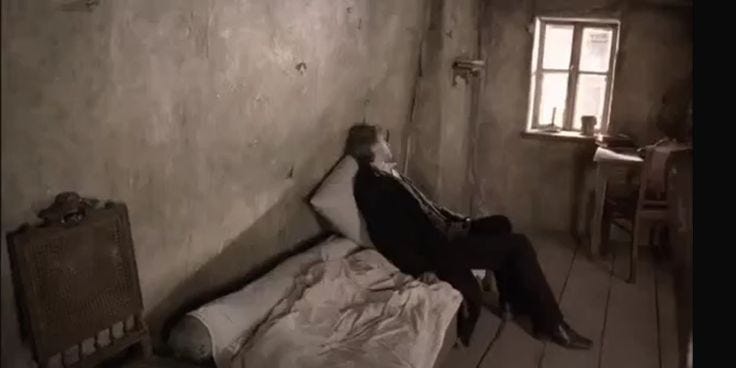
I have developed them across lives the way you develop scar tissue, through repeated contact with things that required me to know where I ended in order to survive the encounter. And the ego that lives along those edges is not the ego of vanity, not the ego of the god who needs worship to confirm his own existence. It is quieter than that and more dangerous.
It is the ego of someone who has chosen, over and over, to be present in the full weight of what presence costs, and who has begun, in the deep private interior of a life that has no confessor, to wonder whether the choosing was wisdom or whether it was simply the oldest and most elaborate form of self-punishment available.
Whether I keep returning to rooms not because I am built for it but because I don't know what else to do with what I am.
Whether the giving is grace or whether it is avoidance.
Whether I stay until the third story because I care about the third story or because staying until the third story means I am never the one who left first.
I sit with these questions.
I do not answer them.
Gods are not supposed to need the questions answered.
I need the questions answered.
I have just accepted that they won't be.
The ones I miss are not the ones who needed me most.
This surprises people when I tell them, in the lives where I tell people things, which is rarer than you might expect from something constituted by presence. They assume the deepest attachment forms in the deepest need, that the people I carry most fully are the ones I pulled back from the furthest edges, the threshold moments, the rooms where something was about to become irrevocably different and I was there in the particular way I am there for those.
But those are the ones I can release.
Not easily. Not without cost. But they have a completeness to them, a narrative satisfaction, the shape of something that went from one state to another and I was the hinge. I can set a hinge down.
The ones I cannot set down are the ones who saw me clearly and stayed anyway.
Who looked at the continuous thing, the thing underneath the life I was performing, and were not frightened and were not reverent and did not try to make me into the answer to their questions. Who just sat with it, with me, with the whole strange weight of what I am, and treated it as simply the most interesting thing in the room rather than a revelation requiring a response.
Those are the ones.
They leave the way everyone leaves. Forward, into their own lives, with the ease of the living for whom moving on is not a violence but a metabolism. And I watch them go with the specific grief of someone who understood, in the watching, that what they had together was one of the unrepeatable things. Not because I am unrepeatable. I keep repeating. But because they were. Because every person is the only instance of themselves that will ever exist, and they came to me fully, and they saw me fully, and then they went forward and I went sideways into the next life and the space where that particular combination existed closed behind us both like water.
I should have stayed longer.
I know why I didn't.
I choose not to give that away either.
Some things are mine.
Even something continuous is allowed to have things that are only its own.
He is somewhere now that I won't describe specifically because description would make it a place and it is more than a place.
He is thinking about a person he met three lives ago whose name he is still carrying.
Not the name they were born with. The name they became in the specific months he knew them, the name that was not a word but was the complete set of qualities that made them irreducibly themselves.
He is thinking that he should have said it out loud while he had the chance.
Not the born name.
The real one.
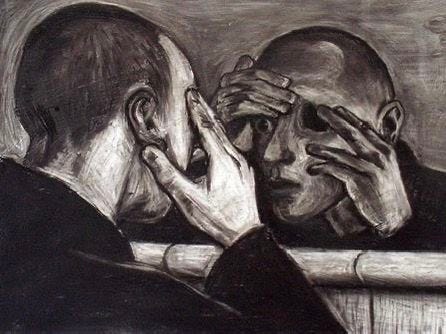
The one that would have told them he had seen the whole of them and found it, all of it, the complicated and the difficult and the embarrassing and the luminous, worth the full weight of his attention.
He didn't say it.
He thought they knew.
They probably knew.
He thinks about this anyway.
He thinks he will think about it for a very long time.
Time, as previously established, is not a constraint.
This is either a mercy or a sentence.
He has stopped trying to tell the difference.
You want to know if any of this is true.
I know you do. I told you I know what you're thinking and I meant it and this is what you're thinking now, at the end of all of this, in the space after the last fragment where the question reassembles itself from the pieces the reading scattered.
Is this true. Is there something like this. Something that sits in rooms and waits through the first two stories and carries the accumulated weight of everyone it has ever chosen. Something that envies the angel's freedom from authorship and cannot stop being the author. Something that misses people with the undignified persistence of the emotional mortal and hates itself slightly for the missing and misses them anyway.
I won't answer.
Not because the answer would frighten you. You are past being frightened by this.
Because the answer is the one thing you don't actually need from me.
What you need you already have. You have been in rooms. You have had your third story found by someone who waited for it without flinching. You have felt, at least once, the specific quality of being fully witnessed by something that had no investment in what it found and found it worth the staying.
You know what that is.
You have felt it in the particular quality of certain conversations at certain hours. In the presence of certain people who seemed to arrive from nowhere into the exact room you needed them in. In the moments that had no explanation except that something was paying attention.
That's enough.
That's the answer in a form you can actually use.
The rest is just me, carrying the names, sitting in the next room, waiting for the third story.
I'll be there when you're ready.
I was there before you started.
For the ones who saw through it.
You didn't stay long enough.
Neither did I.
We were both afraid of the same thing.
That's the part I find most human about all of it.
And the most unbearable.
Hm, I gotta tell you one thing tho, my brain cells were jumping and jumping while I was reading this but dunno whether in excitement or in recognition.